What is Creative Commons License?
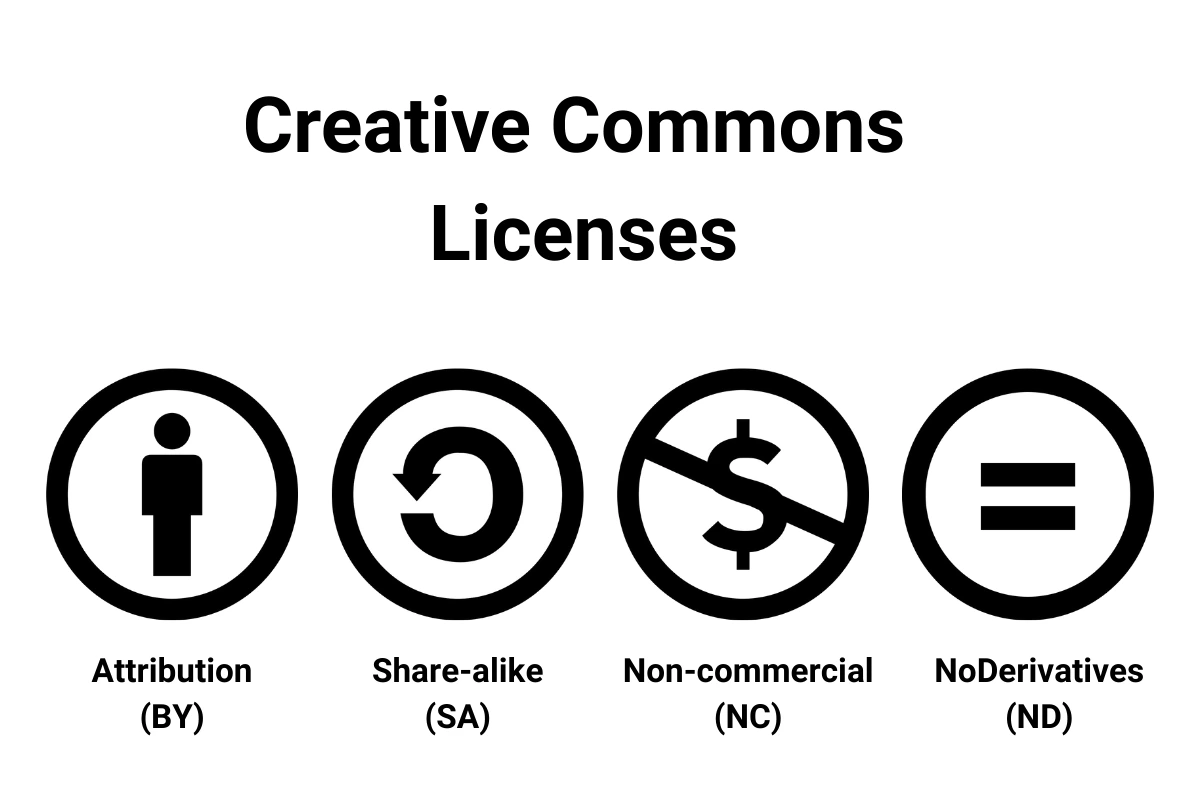
Creative Commons licenses are public copyright tools that allow creators to share their work while specifying reuse conditions. These licenses grant baseline rights like distribution and use, with options for restrictions such as non-commercial purposes or requiring attribution.
Key Features of Creative Commons Licenses
All Creative Commons licenses require attribution to the original creator. They are irrevocable, non-exclusive, and royalty-free, enabling global sharing without needing direct permission from the author.
License Variations
Six main licenses combine four conditions:
- Attribution (BY)
- ShareAlike (SA)
- NonCommercial (NC)
- NoDerivatives (ND)
For example, CC BY allows remixing, while CC BY-ND prohibits modifications.
Creative Commons Licenses Types
Creative Commons licenses vary in permissiveness based on four core conditions:
- Attribution (BY)
- ShareAlike (SA)
- NonCommercial (NC)
- NoDerivatives (ND)
These combine into six main licenses, plus CC0 for public domain dedication, allowing creators to control reuse while enabling sharing.
Additional License
CC0 provides a public domain dedication, waiving all copyright where possible. These licenses support education, research, and open access by making permissions clear and standardized.
Creative Commons License Comparison
Which CC License is Best for Allowing Commercial Use?
CC BY is the best Creative Commons license for allowing commercial use, as it permits distribution, remixing, adaptation, and building upon the material in any medium for both commercial and noncommercial purposes, with only attribution required.
Three licenses enable commercial use, ranked by openness:
- CC BY: Most permissive, full reuse including derivatives.
- CC BY-SA: Allows derivatives but requires sharing them under the same license.
- CC BY-ND: Permits sharing originals commercially but bans modifications.
Considerations
Avoid NC (NonCommercial) variants like CC BY-NC if commercial use matters, as they prohibit monetary gain. CC BY maximizes reach while protecting attribution rights.
Source:
- https://copyrightalliance.org/faqs/what-is-creative-commons-license/
- https://creativecommons.org/licenses/by/4.0
- https://creativecommons.org/share-your-work/cclicenses/
- https://help.oapolicy.universityofcalifornia.edu/support/solutions/articles/9000226762-which-creative-commons-license-should-i-choose-
- https://pose.open.ubc.ca/open-education/creative-commons/what-are-the-different-types-of-creative-commons-licenses/
- https://guides.lib.utexas.edu/cc/types
- https://www.saskoer.ca/creativecommons/chapter/license-types/
- https://smartcopying.edu.au/what-is-creative-commons/
- https://teaching.resources.osu.edu/teaching-topics/simple-guide-creative-commons
- https://copyright.psu.edu/copyright-basics/creative-commons/
- https://guides.loc.gov/p-and-p-rights-and-restrictions/creative-commons-definitions
- https://www.youtube.com/watch?v=Dy5sRDxjFJY
- https://libguides.sunysccc.edu/c.php?g=1409648&p=10531682
- https://www.reddit.com/r/opensource/comments/1eb9j8d/choosing_an_open_source_license_for_a_commercial/
- https://www.lib4ri.ch/cc-licences
- https://www.copyrightlaws.com/creative-commons-licenses-choose-best/
- https://open.ed.ac.uk/how-to-guides/choosing-a-creative-commons-licence-for-your-resource/