GIGO: Garbage In Garbage Out
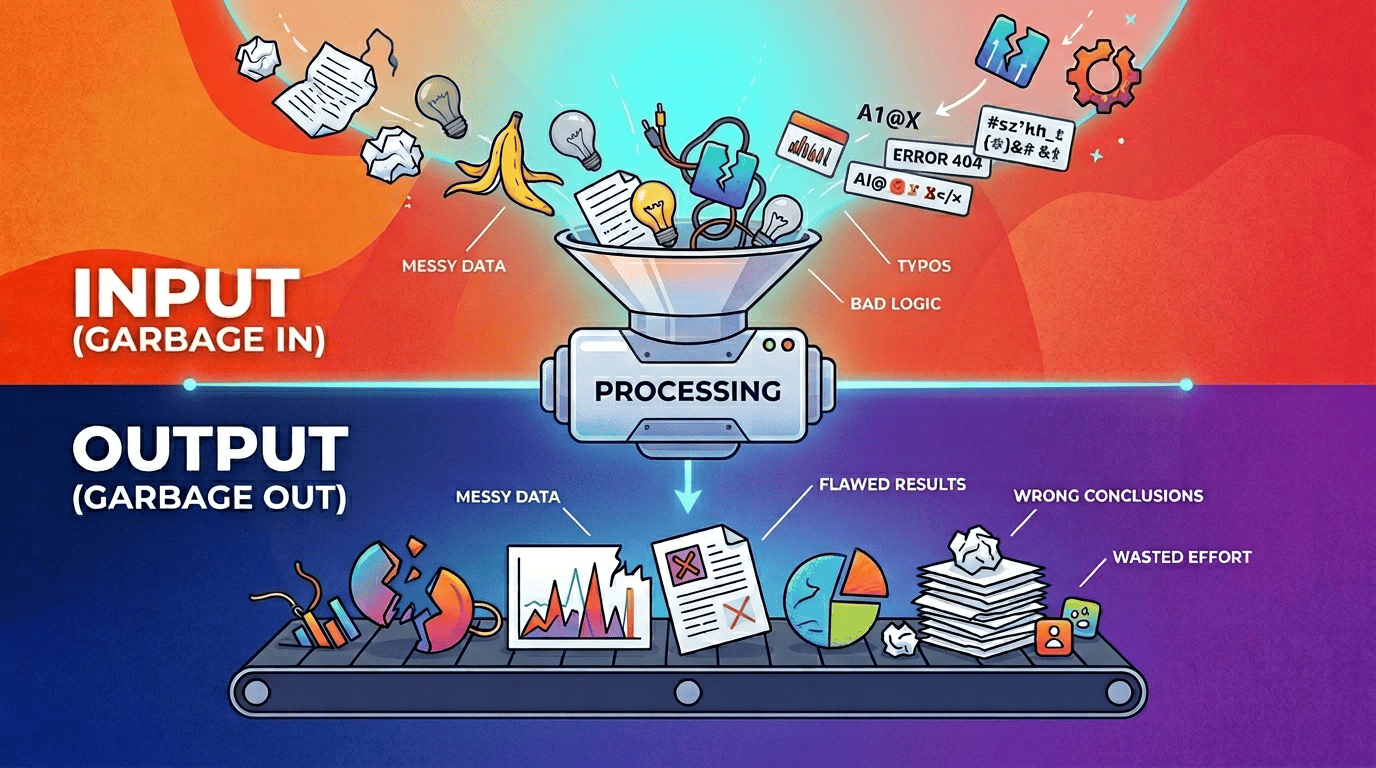
GIGO is a foundational concept in computer science and mathematics that stands for Garbage In, Garbage Out.
It refers to the idea that the quality of an output is strictly dependent on the quality of the input. Even if a system, algorithm, or program is perfectly designed, it will produce a flawed or “garbage” result if the data fed into it is incorrect, incomplete, or poorly formatted.
Key Areas of Application
- Software Development: If a function expects a specific data type (like an integer) but receives a string, the program will either crash or return an illogical result.
- Data Analysis & SEO: If you analyze a website’s performance using corrupted or filtered traffic data, your resulting strategy will be based on a false reality.
- Artificial Intelligence: Large Language Models (LLMs) and Generative AI are heavily susceptible to GIGO. If a model is trained on biased or factually incorrect text, its responses will reflect those same errors.
- Daily Logic: In a broader sense, it applies to decision-making. If you make a choice based on bad advice or false information, the outcome is rarely successful.
A Practical Example of GIGO
Imagine a calculator designed to find the average of two numbers:
- Good Input: You enter 10 and 20. The system works correctly and gives you 15.
- “Garbage” Input: You accidentally enter 10 and 200 (a typo). The system still works perfectly, but it gives you 105.
The calculator didn’t fail; the input was the “garbage,” so the output was naturally “garbage” in the context of your goal.
How to Prevent GIGO
To avoid this, developers and data scientists use several safeguards:
- Data Validation: Checking if data meets certain criteria before it is processed.
- Data Cleaning: Removing duplicates, fixing typos, and filling in missing values in a dataset.
- Sanitization: Ensuring that input doesn’t contain malicious code or unexpected characters.
Frequently Asked Questions about GIGO
1. Is GIGO only applicable to computer programming?
No. While it originated in computer science, the principle applies to any system that processes information. This includes data analytics, machine learning, business decision-making, and even personal logic. If you base a business strategy on incorrect market research, the resulting strategy will be flawed regardless of how well it is executed.
2. How does GIGO affect Artificial Intelligence and LLMs?
AI models are entirely dependent on their training data. If an AI is trained on biased, outdated, or incorrect information, it will generate “hallucinations” or biased responses. In prompt engineering, if your instructions to the AI are vague or contradictory (Garbage In), the response you receive will likely be unhelpful (Garbage Out).
3. What is the difference between a “System Error” and GIGO?
A system error occurs when the processing mechanism itself breaks (e.g., a software bug or hardware failure). GIGO occurs when the system functions perfectly but produces a useless result because the input was wrong. In GIGO, the logic of the “machine” is sound, but the “fuel” is contaminated.
4. Can data validation completely eliminate GIGO?
Data validation can significantly reduce GIGO by catching technical errors (like a letter in a phone number field), but it cannot always catch contextual errors. For example, if a user enters “30” instead of “300” for a price, the system may accept it as a valid number, even though it is factually incorrect for that specific transaction.
5. How can businesses prevent GIGO in their databases?
Prevention involves a multi-layered approach:
- Sanitization: Cleaning data as it enters the system.
- Standardization: Ensuring all data follows the same format (e.g., $DD/MM/YYYY$ for dates).
- Regular Audits: Periodically reviewing databases to remove “rot” (outdated or duplicate information).
- User Training: Ensuring that the people entering the data understand the importance of accuracy.