What is Pair Programming?
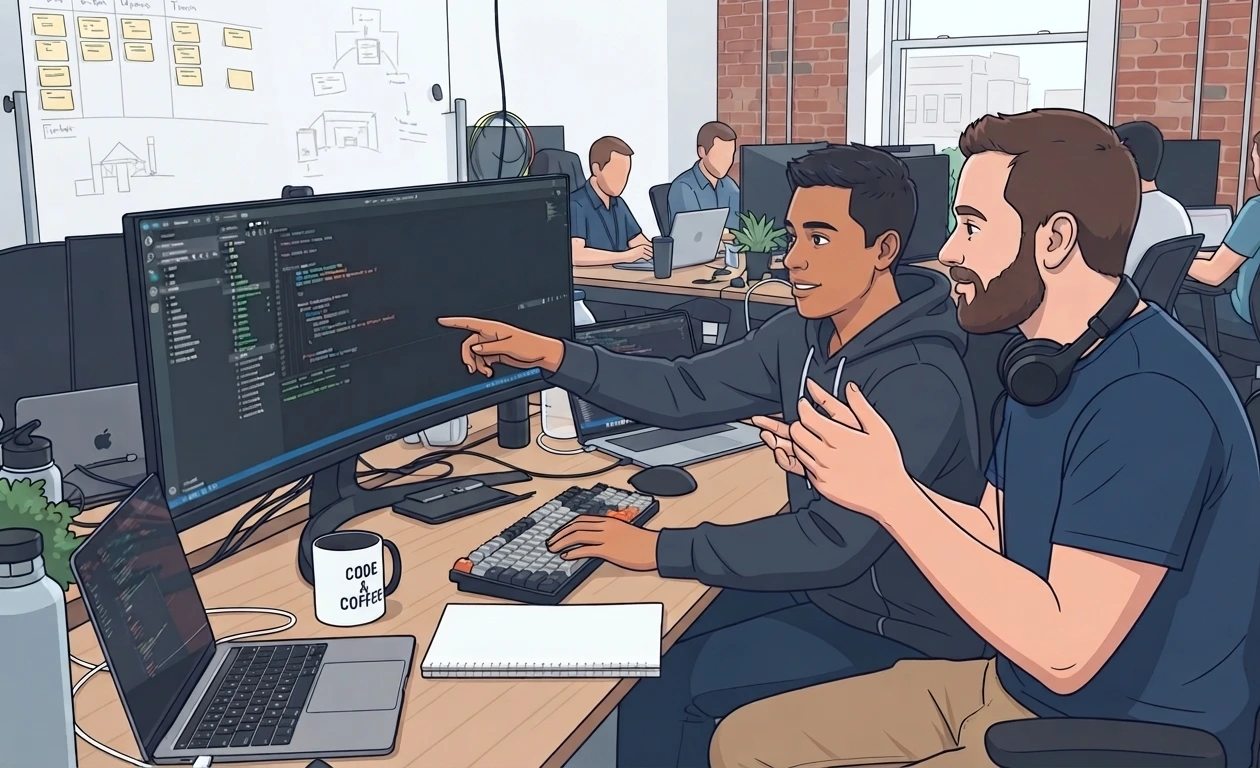
Pair programming is a quick software engineering technique where two developers share a single computer (one screen, keyboard, and mouse) and work together.
While one engineer acts as the active executor of the syntax, the other provides a high-level perspective, reviewing the direction, anticipating edge cases, and looking up references. They do not simply work alongside one another; they merge their cognitive strengths to produce superior, bug-free software.
Real-time peer checking captures errors immediately before compiling.
Knowledge distributes instantly across the team, lowering silos.
Instead of checking code hours or days later inside pull requests, feedback is immediate. Developers communicate continuously:
- brainstorming designs,
- correcting spelling,
- reviewing algorithms
- sharing terminal shortcuts.
Solo Development vs. Pair Programming
Solo developers build high-risk dependencies. Pair developers write continuous, collective intelligence directly into the main branch.
Solo Development
Only one engineer holds the logical map of the system. Critical system outages trigger severe downtime if that person is offline.
Code reviews happen days after implementation, causing endless context switching, build breaks, and rework delay.
Solitary coding makes switching to messaging channels, social tabs, or off-topic reading highly tempting and common.
Pair Programming
Multiple team members are fully conversant with the source logic, maintaining high system durability and a low “Bus Factor”.
The Navigator identifies bugs, style violations, and design gaps immediately as they are typed, saving days of PR queue delay.
Mutual commitment keeps both partners intensely focused on the screen, building healthy social discipline against outside noise.
Collaborative Minds with Pair Programming
Successful pairing splits focus mathematically: one operates tactically at short range, while the other navigates strategically at long range.
The Driver — “The Tactical Mind”
The Driver owns physical custody of the input peripherals. Their job is execution: crafting high-fidelity syntax, adhering to clean styling guidelines, solving the immediate compiler problem, and naming functions correctly.
What are the Benefits of Pair Programming?
Pair programming has some benefits, such as accelerating code development and improving communication between team members.
- Higher Code Quality: Catching bugs and logical errors in real-time, reducing the need for extensive debugging later.
- Knowledge Transfer: Share skills, languages, and system architecture details naturally between team members.
- Faster Problem Solving: Two minds tackle complex architectural challenges or roadblocks much quicker than one.
- Better Maintainability: Code tends to be cleaner and simpler since it has to be easily understandable by another person.
- Improved Focus: Minimizes distractions and multitasking, keeping both developers engaged on the task at hand.
- Team Cohesion: Strengthens communication, collaboration, and trust across the development team.
Related Contents