Untangling Spaghetti Code
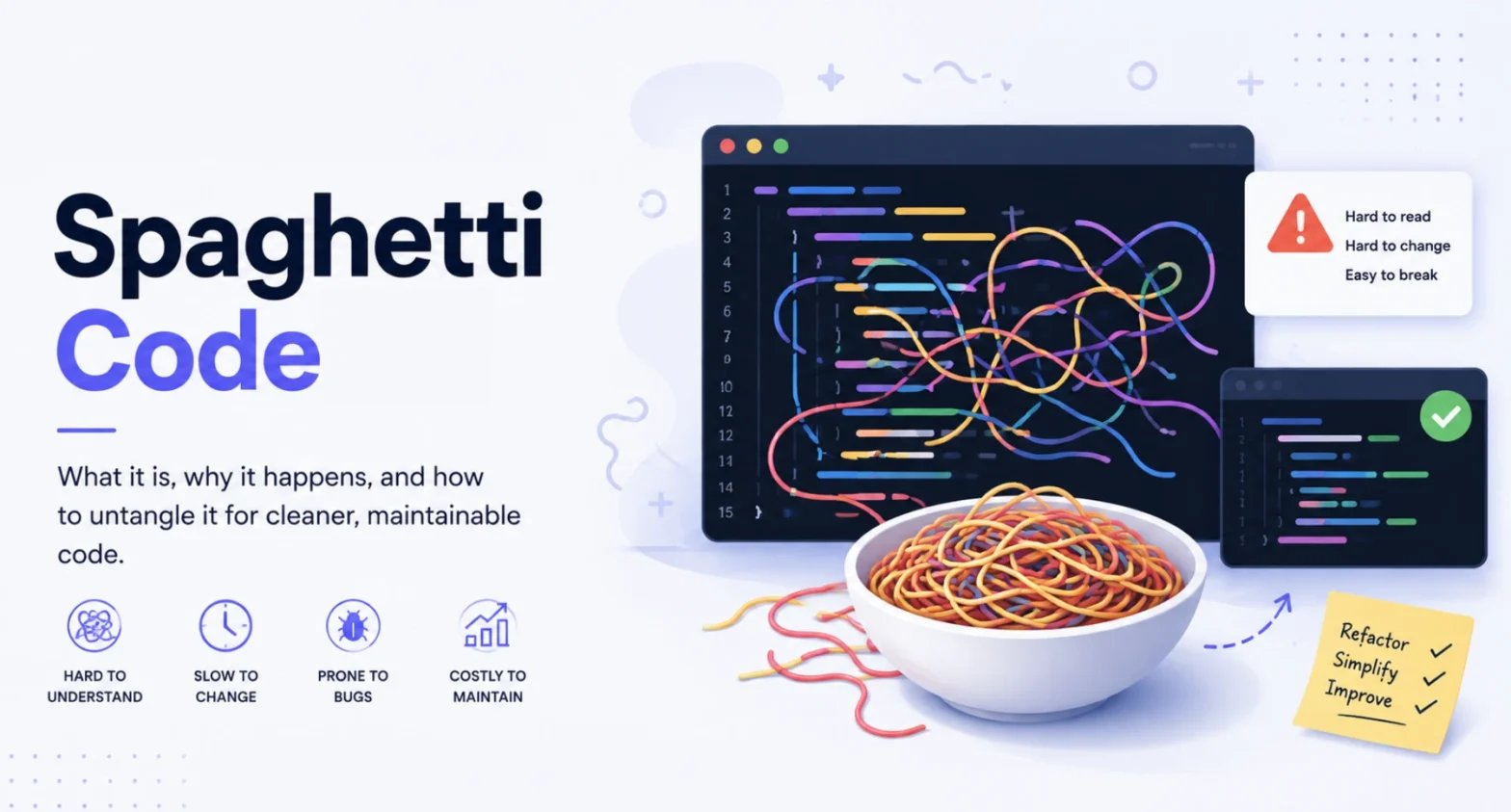
An exploration into control flow anti-patterns, the history of unconstrained execution, and practical strategies for building modular, maintainable software.
1. What is Spaghetti Code?
Spaghetti Code is an informal term for computer source code that has a complex, convoluted, and tangled control structure. Like a bowl of intertwined noodles, following the thread of execution from input to output requires tracing unpredictable jumps, global variable mutations, and side effects across multiple distant routines.
When a codebase becomes spaghetti, adding a single feature or fixing a minor bug frequently triggers unexpected failures in seemingly unrelated parts of the application.
In early assembly and procedural languages (BASIC, FORTRAN, early C), programmers relied heavily on unconstrained GOTO jumps to move execution across line numbers. In March 1968, Dutch computer scientist Edsger W. Dijkstra published his seminal letter “Go To Statement Considered Harmful”, arguing that human cognitive limits require execution structure to mirror static code organization.
2. The Architectural Pasta Taxonomy
In software engineering lore, different architectural flaws are affectionately named after pasta types based on their structural layout:
Code where control flows unpredictably in arbitrary jumps, global variable mutations, and callback chains with no clear modular boundaries.
- •High coupling: Modifying 1 file breaks 5 unrelated features
- •Deep conditional nesting (> 4 indentation levels)
- •Heavy reliance on global state or window variables
- •Difficult or impossible to write isolated unit tests
// ❌ Spaghetti Code Example
function handleUserOrder(e) {
  window.currentUserState.status = "processing";
  if (e && e.target && e.target.dataset) {
    validateCart(window.cart, function(err, valid) {
      if (!err && valid) {
        chargeCard(function(paymentRes) {
          if (paymentRes.ok) {
            window.location.href = "/success";
            updateGlobalDatabaseDirectly();
          }
        });
      }
    });
  }
}
3. Interactive Execution Map
Tangled Spaghetti FlowVisualize function call graphs in real-time. Notice how tangled dependencies create unpredictable, cross-cutting execution paths versus clean, unidirectional layered architecture.
Click any function node in the execution map above to inspect its dependencies and side effects.
4. Refactoring Anti-Patterns
Compare common spaghetti patterns directly with clean, refactored alternatives:
// ❌ Tangled Callback Spaghetti
function getUserDashboard(userId, callback) {
  db.findUser(userId, function(err, user) {
    if (err) return callback(err);
    db.getOrders(user.id, function(err, orders) {
      if (err) return callback(err);
      db.getStats(orders, function(err, stats) {
        if (err) return callback(err);
        callback(null, { user, orders, stats });
      });
    });
  });
}// ✅ Clean Flattened Async Pipeline
async function getUserDashboard(userId: string): Promise<DashboardData> {
const user = await db.findUser(userId);
const orders = await db.getOrders(user.id);
const stats = await db.getStats(orders);
return { user, orders, stats };
}5. The 5 Rules for Clean Control Flow
Single Responsibility Principle (SRP)
Every function, module, or component should have one, and only one, reason to change. Separate DOM handling from business domain rules.
Guard Clauses over Deep Nesting
Return early on invalid state or missing parameters. Keep the primary execution path aligned along the left margin of your editor.
Pure Functions & Explicit Contracts
Prefer functions that return new data rather than mutating shared global arguments or window state.
Unidirectional Data Flow
Data should flow downward from parent to child, and events should flow upward. Never create bidirectional event loops.