Programmatic SEO

Programmatic SEO
50
09/08/2026

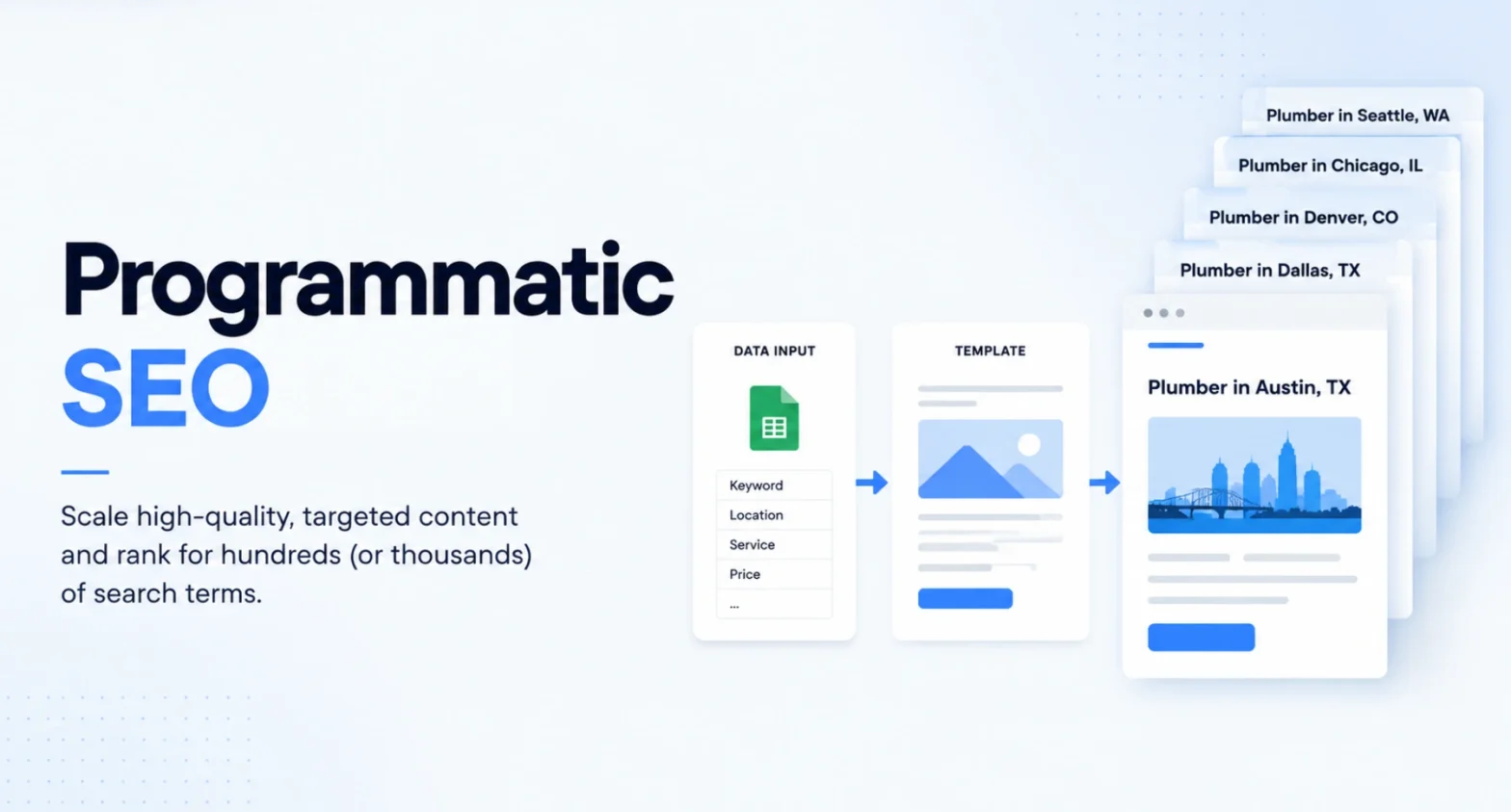
Programmatic SEO is a method that creates thousands of pages by combining a single structured database with dynamic code templates to generate thousands of high-intent, indexable landing pages automatically. Instead of writing a lot of blog posts manually or creating pages.

pSEO most commonly stands for Programmatic SEO.

pSEO Architecture

pSEO Architecture Pipeline Simulator
1 Database x 500 Records=500 Indexed Landing Pages
Step 1: Structured Dataset
Record Object:{
  service: “Plumber”,
  city: “Austin”,
  slug: “plumber-in-austin”
},{
  service: “Plumber”,
  city: “Miami”,
  slug: “plumber-in-miami”
},{
  service: “Electrician”,
  city: “Denver”,
  slug: “electrician-in-denver”
},{
  service: “CPA Accountant”,
  city: “Seattle”,
  slug: “cpa-accountent-in-seattle”
}
Step 2: Dynamic Template

Single component that consumes dataset props dynamically.

// ServicePageTemplate.tsx
export default functionPage({ city, service}){
<Head>
  <title>Top Rated{service} in{city}</title>
</Head>
<h1>Best{service} in{city}</h1>
}
Compile Engine Running…
Step 3: Google Search Result

Live preview of how Google indexes this generated landing page.

https://yourdomain.com/services/plumber-in-austin
Top Rated Plumbers in Austin (2026 Reviews)

Compare pricing, read verified reviews, and book top local plumbers operating in Austin. Average call response time under 20 mins.

Ready for Google Indexation

Unique URL, dynamic title, and Schema structured data.

The 4 Pillars of Programmatic SEO

A successful programmatic strategy requires harmonizing keyword math, structured data, web templates, and crawl architecture.

Pillar 01 Blueprint
1. Head Terms & Modifiers

Programmatic SEO relies on identifying repeatable search query formulas composed of a fixed Head Term and variable Modifiers.

Head Term: The core topic or service (e.g. “Software Alternatives”, “Plumber”, “Integrations”).
Primary Modifier: Key variable (e.g. “{Tool_Name}”, “{City}”, “{App_A} to{App_B}”).
Secondary Modifier: Additional long-tail descriptors (e.g. “for Startups”, “in 2026”, “with Free Trial”).
Architecture Pattern:[Head Term] + [Modifier 1] + [Modifier 2]
code-example.tsTypeScript / React
// Example Formula Mapping:Search Pattern: “Best [Category] in [City], [State]”Record 1: “Best Coffee Shops in Austin, TX”Record 2: “Best Coffee Shops in Seattle, WA”Record 3: “Best Coffee Shops in Denver, CO”

Pillar 02 Blueprint
2. Structured Dataset

The quality of your pSEO program depends entirely on unique, accurate, and structured dataset attributes. Thin or duplicated data gets flagged by Google.

Data Sources: Custom scraping, proprietary internal analytics, public APIs, or Airtable/PostgreSQL.
Data Attributes: Provide 5-10 unique data points per row (e.g. pricing, ratings, location coordinates, features list).
Programmatic Insights: Pre-calculate unique summaries or statistical medians per page to guarantee non-duplicate content.
Architecture Pattern:Database Table (PostgreSQL / CSV / Airtable)
code-example.tsTypeScript / React
[ { “slug”: “austin-tx-plumbers”, “city”: “Austin”, “state”: “TX”, “avg_cost”: “$95/hr”, “verified_pros”: 42, “top_neighborhoods”: [“Downtown”, “East Austin”, “Mueller”]}]

Pillar 03 Blueprint
3. Dynamic Templates

Single React, Next.js, or Astro page templates that pull record data via params to construct high-speed, SEO-optimized HTML.

Metadata Injection: Dynamic
Architecture Pattern:Framework (Next.js App Router / Astro / React)
code-example.tsTypeScript / React
export async function generateMetadata({ params}){ const data=await getPseoRecord(params.slug); return{ title: `Top ${data.service} in ${data.city} |${data.year}`, description: `Compare ${data.verified_pros} verified ${data.service} pros in ${data.city}.`}}

Pillar 04 Blueprint
4. Internal Linking Architecture

Google must be able to discover and crawl thousands of generated pages effortlessly without wasting crawl budget.

Hub & Spoke Pattern: Create category index pages (e.g. /services/plumbers) linking to all city spokes.
Dynamic Cross-Linking: Link related pages at the bottom (e.g. “Other services in Austin”, “Plumbers in nearby cities”).
XML Sitemap Chunking: Split sitemaps into smaller 5,000-url XML files (sitemap-services-1.xml).
Architecture Pattern:Hierarchy: Home -> State -> City -> Service Page
code-example.tsTypeScript / React
<div className=”related-links”> <span>Explore Plumbing Services in Nearby Cities</span> <ul> {nearbyCities.map(c=> ( <li key={c.slug}><a href={`/services/plumber/${c.slug}`}>{c.name}</a></li> ))} </ul></div>

Google Guidelines & Risk Prevention

How to scale thousands of pages safely without triggering Google’s Helpful Content System or spam penalties.

Advertisement
Continue Reading Below
Related SEO Topics